Hawkins Holistic

Naturally Yours

Tag: yoga

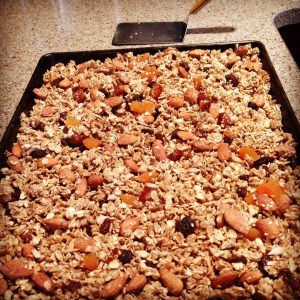
Yogi Granola: a recipe
photo

No, I’m not being ironic or “cute” when I say ‘Yogi Granola‘. It’s the real deal. Everyday at the ashram the hundreds of yogis were served home-baked granola at brunch. It was by far my favourite sweet treat at the ashram. So, when I returned home I went into granola withdrawal. Store bought granola has always been a sore spot for me (too much sugar, or so little quantity of the good stuff for a lot of $). Alas, the Sivananda organization has freely shared a recipe for their granola. I tried it out and I am one happy camper (although I’m no longer actually camping..sad face).

Here is the recipe, with a few tweaks a la Hawkins Holistic (I found this recipe wasn’t sweet enough, and didn’t need the amount of wheat as originally called for).

YOGI GRANOLA

  • 1/2 cup maple syrup
  • 1/3 cup agave syrup
  • 1/2 cup hot water
  • 1 tsp vanilla extract
  • 5 cups rolled oats (I use Bob’s Red Mill large flake, GF)
  • 5 tbsp wheat bran
  • 5 tbsp wheat germ
  • 2 tbsp ground flax
  • 3/4 cup almonds
  • 1 cup sunflower seeds
  • 1/3 cup sesame seeds
  • 2 tsp ground cinnamon
  • 1/2 cup golden raisins or raisins
  • 1/3 cup chopped dates or other dried fruits (I used dried apricots)

~ Heat the oven to 250F. Combine the maple syrup, agave, hot water, and vanilla extract.

~ Mix the grains, nuts, seeds and cinnamon in a large mixing bowl. Stir in the maple syrup solution and mix thoroughly. Spread out the mixture on a lightly greased baking sheet and bake in the oven for 45-55mins, stirring three or four times to prevent it from burning. The granola is ready when it is light brown.

~ Mix the granola with the dried fruit while still warm, breaking up the larger chunks as you do so.

~ Leave to cool and then store in air-tight containers.

Serve granola with almond milk as a healthy breakfast or snack, or sprinkle some granola atop your favourite dairy-free ice cream for a decadent dessert!

Naturally yours.

To do that which serves you.

photo

Greetings and happy 2015, readers!

I posted this steam of consciousness on Instagram last week, and I thought it relevant to share here also, if only as a reminder for myself this year.

We all de-stress differently. If I’ve learned anything in 2014, it’s that it’s so important – imperative, actually – to discover, develop and regularly practice healthy means of stress reduction. Otherwise known as coping 🙂

For myself, meditation + prayer + yoga + kirtan music takes me down a notch, quiets my “overactive” mind, regulates an agitated nervous system, and creates an inner experience of peace & love. But sometimes it’s a high energy run I need or a leisurely walk or cycle in nature. Sometimes it’s a glass of delicious red wine, savored & appreciated. Sometimes it’s connecting with a good friend, and sometimes it’s being completely alone. Ultimately, we must know ourselves, our limits, and give our minds & body that which it needs in any moment. And those needs are not stagnant, as they change hour-to-hour, day-to-day and year-to-year.

There’s good reason why mental illness is on the rise: being too busy to care for ourselves – as we truly need it – is all to common in western culture, and with all the technological distractions and subsequent shortened attention spans, there is a disconnection from the pulse of life. Literally. The way our heart beats is greatly effected by living in an anxiety state. Tuning in, being quiet and listening to our mind/body’s needs is more important than ever.

My call of action to you in 2015? Simply do that which serves your peace-of-mind, for the short term AND the long term.

Naturally yours.

Sarah Hawkins, R.H.N.

Pranayama Yoga

Picture 2

Modern science shows us that practicing yoga has immense benefits in all aspects of health – physical, mental, social, and spiritual. But how does one apply that science to their life? Answer…via Dr. Bhopal!

Last weekend, I was given the opportunity to attend one of Dr. Jaswant Bhopal’s pranayama yoga & meditation classes. In 2 hours time he eloquently guided students through breathing techniques that heal and soothe both mind & body. I didn’t know what to expect going into it – the yoga I’ve done in past has been that of the mainstream variety – but I left a changed person. My eyes have been opened to yet another natural, non-invasive way to effectively promote health and practice mindfulness.

A bit about Dr. Bhopal…he’s an assistant clinical professor, physician, psychiatrist, spiritual preceptor, yogi, toastmaster and poet. Ya know, just yer average guy. For those of you who like to know why something works – for e.g., how exactly does this breathing exercise slow down the sympathetic nervous system – Dr. Bhopal can tell you. And he can tell you how adopting a ‘Prana-Life’ is comparable in effectiveness to prescription meds when dealing with mood disorders.

If I could go to Dr. Bhopal’s class every day I absolutely would, but because that’s not an option, my intent is to practice the breathing techniques and study the Prana-Life principles (see below).

If you are based in and/or around Vancouver BC, I highly recommend attending Dr. Bhopal’s next monthly class (it’s free by the way!). Check here for details.

 BENEFITS OF PRANAYAMA

Increases Decreases
  • Oxygenation of tissues
  • Immunity
  • Vagal tone (the degree of activity within the parasympathetic nervous system, e.g. heart rate)
  • Hormonal balance
  • Melatonin (the sleep hormone)
  • Alpha rhythms on the EEG (rhythmic electrical cycles in the brain)
  • Body’s own healing propensities
  • Toxins
  • Mental stress
  • Hypertension
  • Heart rate

PRANA-LIFE PRINCIPLES

Doing Good to Others: Doing Good to Self 
Non-violence ~ not harming other sentient (i.e. emotional) beings, including one’s self, and not harming the environment. Non-violence includes practicing tolerance and not speaking ill of others, even if based in truth.

Truthfulness ~ not deceiving or intending to deceive others or ourselves in our thoughts, words or actions.

Non-stealing ~ only take something with permission.

Sexual propriety ~ regarding others as human beings rather than as male or female bodies. Sexual activity, within a committed relationship, ensures the conservation of our energy for spiritual practice.

Abstention from greed ~ not coveting that which is not ours, and avoiding the acquisition of unnecessary objects.

Cleanliness ~ internal and external, such as moderation in diet. Cleanliness also implies avoiding the impurities of mismanaged anger and egoism.

Contentment ~ acceptance of the external situation that we have been allotted in life while not being complacent about injustice.

Austerity ~ committing to our yoga and spiritual practice.

Self-study ~ looking within one’s self, and contemplating and applying the spiritual scriptures of our chosen path.

Surrender to a higher power ~ surrendering to God or a higher principle other than one’s limited self. It implies cultivating the senses of modesty and humility.


 Naturally yours.